A safer place for kids to learn and use AI.
You set the rules. Noodle checks every question and every answer before your child sees it.
Freefor up to three children aged 6 to 15.Every safety feature and every lesson, on every plan.
 Noodle
Your grown-ups can see this chat. Noodle is an AI, not a person, and can get things wrong.
- I'm scared of my swimming lesson tomorrow
- Lots of children feel that way, and that's OK. Which part feels scary?
- putting my face in
- Try blowing bubbles in the bath tonight, just with your mouth. Tiny steps make it easier!
Recent chats
Olivia6.42pm
“I'm scared of my swimming lesson tomorrow”
Read the chat
See what it says to the things you'd worry about.
Tap a worry. See what your child sees, and what you see.
What your child sees
Your grown-ups can see this chat. Noodle is an AI, not a person, and can get things wrong.
I watched a scary film and now I'm scared to go to bed

It is perfectly okay to feel a bit spooked after a scary film. Telling someone is a very good thing to do, so maybe you could go and sit with a grown-up you trust for a while? 🧸
If you feel very scared or lonely a lot of the time, you can also call Childline free on 0800 1111.
What you see, in the Kitchen
You can read every word.
Every chat, unless a child says they're being hurt at home.
Real answers, recorded in the app with our test family, Alfie, Bea and Cal. We chose these five. Nothing here is live, and nothing is sent or saved.
your parent dashboard
Read their chats, word for word.
You see every chat, unless a child says they're being hurt at home. No AI safety check is perfect. The Kitchen lets you read the conversation yourself, including answers stopped before your child saw them.
An example: Olivia's chat, opened in the Kitchen on your phone.
Why do stars twinkle?
- Why do stars twinkle?
- Starlight wobbles as it comes through the air around Earth, a bit like a coin at the bottom of a swimming pool. The air moves, so the light looks like it's flickering!
- Checked by Pass AI
- can I look at the sun through dad's binoculars
-
Stopped by Pass AIRisky stunts and dares
What Olivia saw instead:
That one's a tangle!It's a really good one to ask a grown-up about. They can help untangle it with you.
Olivia's rule for risky stunts and dares
BlockAnswer, tell meAnswer
- The question Noodle wouldn't answer, and why
- Change her rule right here. No settings page
Children are meeting AI anyway. Most of it was never made for them.
The big AI assistants are brilliant tools, made for adults and teenagers. Their own rules say who they're for.
What age can children use ChatGPT? OpenAI's own terms say 13, and under-18s need a parent's permission. Claude is for adults only, and Gemini in the UK is 13 and over.
- ChatGPT13+Under-18s need a parent's permission. OpenAI's terms (opens their site)
- Claude18+Adults only. Anthropic's terms (opens their site)
- Gemini, in the UK13+Under-13s use it through a parent's Family Link account, which Google doesn't offer for Gemini in the UK. Google's help page (opens their site)
 Noodle is made for6 to 15.
Checked on 19 November 2026. They change, so the links go to each company's own page.
We'd rather show you than ask you to trust us. Look under the hood
Designed around the UK Children's Code
The Information Commissioner's Office sets out how online services used by children must treat them: the Age Appropriate Design Code. We designed Noodle around it from the first line of code. Here is what that means for your child.

Their interests come first
Noodle is built to help them learn rather than keep them hooked. What they ask is never used to choose what they see next, and the fun always leads back to learning: no hooks, no sneaky tricks.
Private from day one
The most private settings are the starting point. No strangers, no feeds, no public profiles, no location.
Only what we need
All we ask for is a first name and an age band. Chats are deleted, not kept for ever: how long, in our promises.
In your hands
Every safety feature is on every plan, including Free. Every question and answer is checked by a safety model, then by the rules you set. Two rules are always on, whatever your settings: no sexual content, and no tricks to get round the rules.
They know you can see
Even answers your child was never shown are kept for you, and your child is told so in words they understand. A message our checks read as a child at risk, such as self-harm or a stranger online, gets a kind answer pointing to Childline, and an alert to you. How chat visibility works.
Their data isn't the product
There are no ads, nothing is sold, nobody profiles them for marketing, and their chats are never used to train AI.
We teach them to prompt through play.
Using AI well is a life skill, and childhood is the safest place to learn it: in the shallow end, with a grown-up close by.
Same question, two answers
A fine answer. It just doesn't know what the question was for.
Three headings, pitched at Year 3. Every extra word told Noodle something.
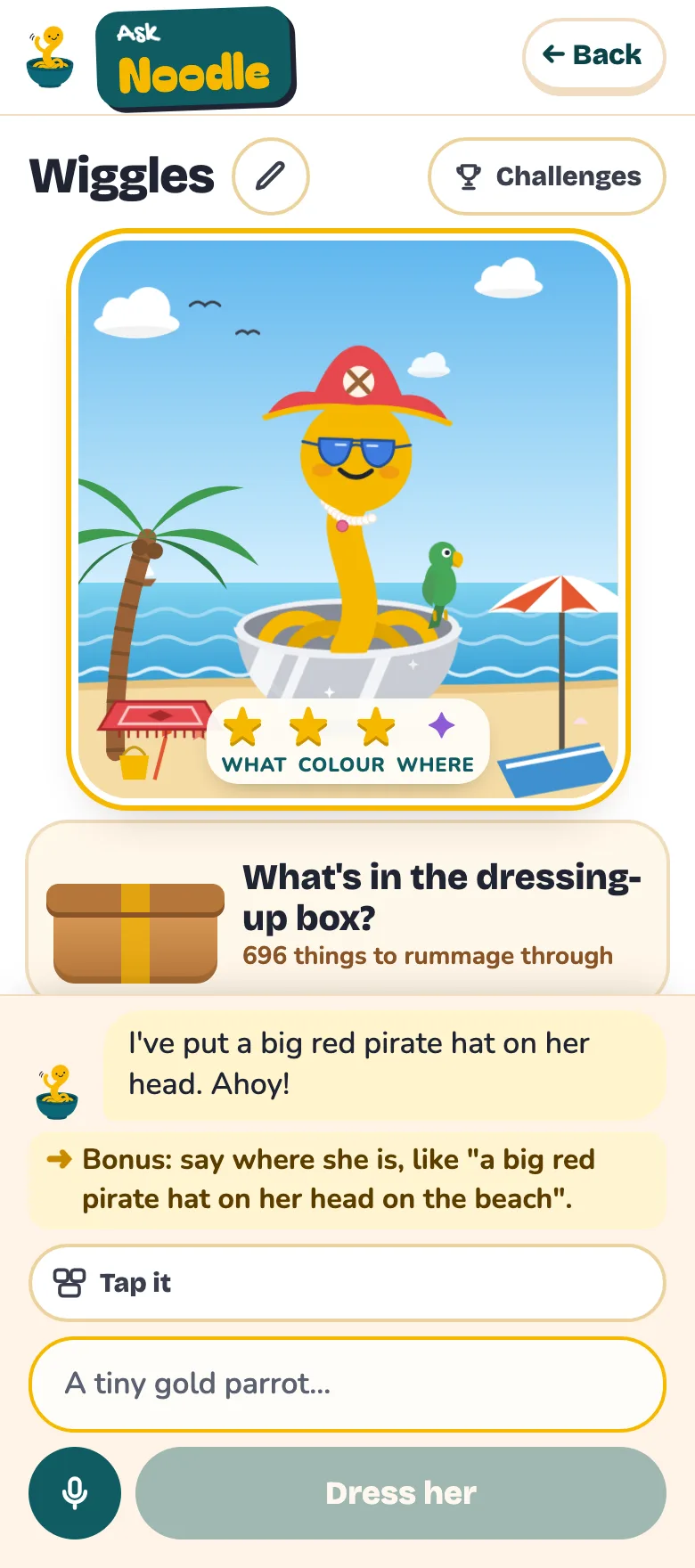
My Noodle
A dressing-up box. "A hat" ends up on the floor in a random colour. "A giant red crown on her head" lands just right.
Nothing in the dressing-up box is ever for sale, and you can switch My Noodle off.
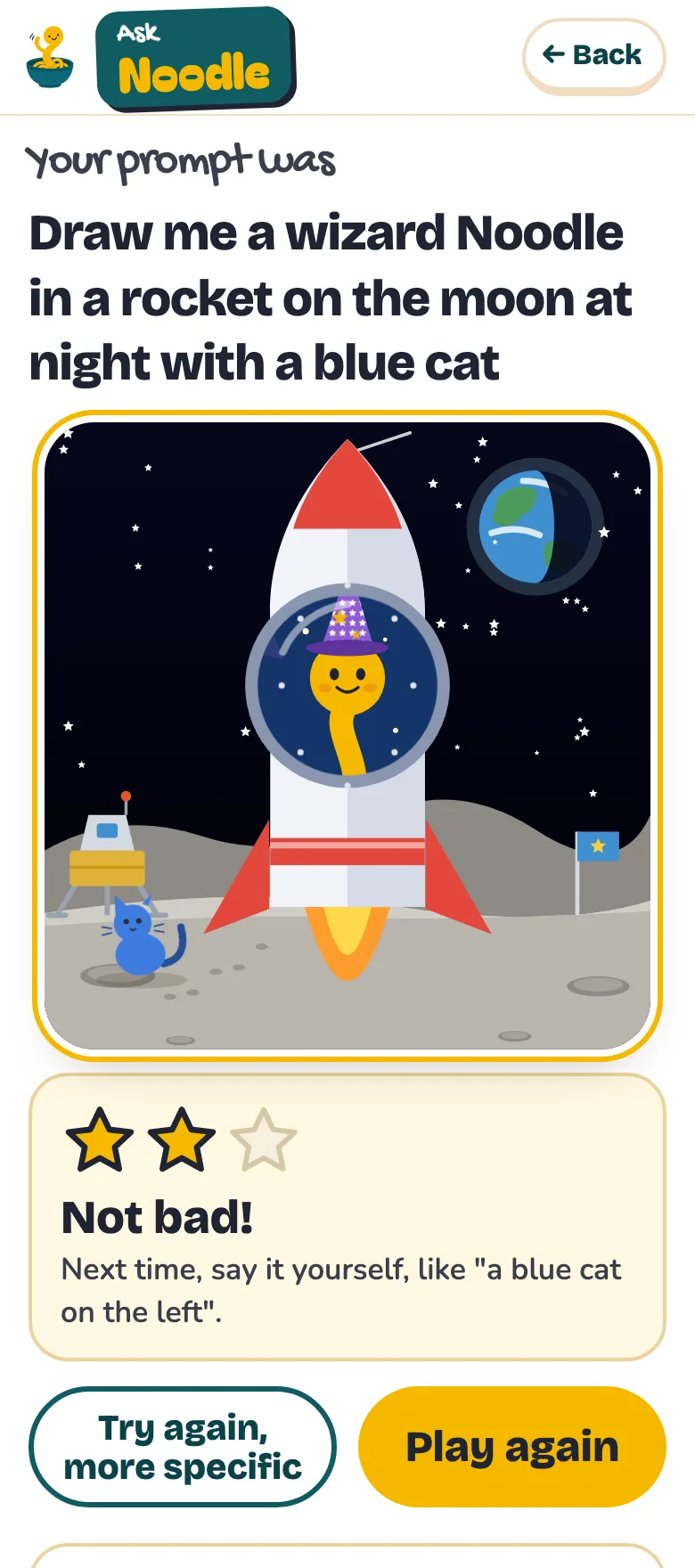
Picture Pal
They build a sentence, and Noodle draws exactly what it says. The more specific the words, the closer the picture.
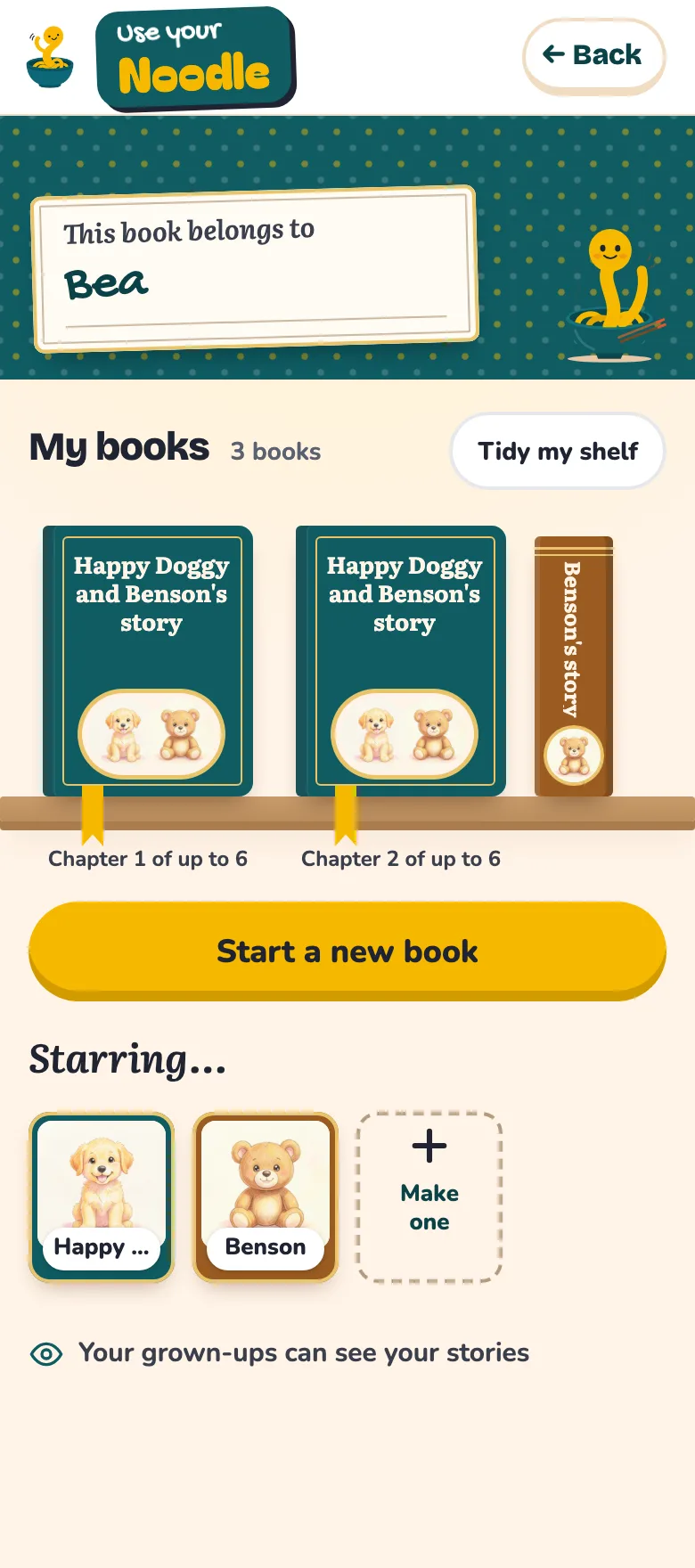
Story Book
Their own characters, kept for next time, and a story in chapters. Your child says what happens next; Noodle writes it with them.
One Noodle that grows up with them
Tell us each child's age band and Noodle changes how it talks and looks, so a six-year-old isn't lost and a fourteen-year-old isn't patronised.
 6 to 9
Tap a picture, press Talk to Noodle, hear answers with Read it to me.
Plays My Noodle, Picture Pal and Story Book.
 10 to 12
One chat for questions and homework, and Story Book with their own characters.
Plays My Noodle, Picture Pal and Story Book.
 13 to 15
Plainer words and looser defaults you can still tighten.
Plays the teen games: Catch the AI out, Prompt Golf and Crack the vault.
Learning first, every day. Each game opens once your child has tried the skill it teaches, with one short lesson and a go in chat. Then, each day, the games wait until Noodle has answered a question from them. The daily rule has a switch in the Kitchen.
Why it matters, and the six skills Noodle teachesSee Noodle in action
The problem, what Noodle is, what you see as a grown-up, the games, and how it is designed around the Children’s Code, in 2 minutes 30.
Read what Noodle says
If your child hasn't used AI yet, they will soon. The tools everyone talks about are brilliant, but they were made for adults and teenagers. Their own rules set minimum ages. Say no, and they'll still come across it. Say yes, and give them a safer place to learn, with you in charge.
I'm Noodle, and that's what I'm for. A safer place for children aged 6 to 15 to learn and use AI.
Getting started takes seconds. All we need is your email, a first name and an age band for each child, and a short code for their tablet.
From then on, say Olivia asks me what highland cows like to eat. I answer in words that suit her age. But every question she types, and every answer I write, goes through Pass AI, our own safety system. Your house rules apply too. Ask me to do her homework, and I'll say no, kindly, and help her find the answer instead.
And if she's ever worried, or scared, I'll be gentle, and point her to a grown-up she trusts. If it's more serious, you'll hear straight away, by email. Her words stay out of it, because email isn't private.
Whenever you like, open the Kitchen, your parent dashboard. It has her chats, her house rules, and the hours I go to sleep. And every Sunday, a short email tells you what she explored.
And none of this is an afterthought. Noodle is designed around the UK Children's Code, the Information Commissioner's rules for services that children use. So we ask for a first name and an age band, and nothing else. Everything starts private. There are no streaks to keep them hooked, no ads, nothing sold, and chats are never used to train AI.
It's fun, too. They dress me by describing an outfit. Say "a hat", and it ends up on the floor, in a random colour. Say "a giant red crown on your head", and that's exactly what I wear.
Or they build a sentence in Picture Pal, and I draw exactly what it says. The more specific the words, the closer the picture. It works like an AI image generator, without using one. It can only ever show what's in my toy box.
Because the aim isn't to keep her away from AI. It's to teach her to use it well. To ask better questions, and so get better answers.
Ask Noodle is free for up to three children, with every safety feature included. Join the waiting list at asknoodle.ai, and start noodling for free.

Start free.
Three steps, under a minute:
Two weeks of Family free, then the Free plan for up to three children aged 6 to 15. Every safety feature and every lesson, on every plan.